Enterprise AI Agents in 2026: What Google Cloud Next Just Revealed
April 24, 2026


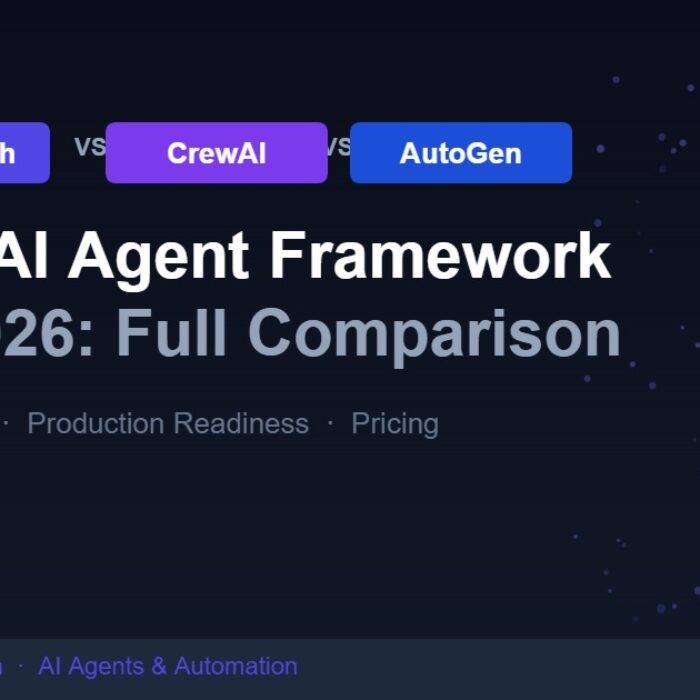
In 2026, choosing the right AI agent framework is one of the most important decisions a developer or business can make. According to a Q1 2026 analysis, LangGraph alone appeared in 34% of production architecture documents at companies with 1,000+ employees — more than any other framework. Yet two other contenders — CrewAI and AutoGen — each have passionate communities and compelling advantages of their own.
If you’re building AI agent workflows, automating business processes, or experimenting with multi-agent AI systems, this guide cuts through the noise. We compare the best AI agent frameworks for 2026 — LangGraph, CrewAI, and AutoGen — across ease of use, production readiness, pricing, and the specific use cases where each one shines.
Whether you’re a developer choosing a framework for your next project or a business leader evaluating agentic AI platforms, this breakdown will help you make the right call.
Before diving deep, here’s a side-by-side overview of where each framework stands in 2026:
| Feature | LangGraph | CrewAI | AutoGen |
|---|---|---|---|
| Design approach | Graph-based orchestration | Role-based agent crews | Conversational multi-agent |
| Learning curve | Steep | Easy | Medium |
| Best for | Production, complex workflows | Rapid prototyping, business teams | Research, Azure ecosystems |
| State management | Excellent (built-in) | Basic | Moderate |
| Human-in-the-loop | Native support | Limited | Good |
| Open source | Yes (MIT) | Yes (open core) | Yes (Microsoft) |
| Paid tier starts at | $39/user/mo (LangSmith Plus) | $99/mo (AMP Cloud) | Free (Azure costs apply) |
| Production maturity | Very High | High | Medium (transitioning) |
LangGraph is the AI agent framework built by the LangChain team, and in 2026, it has established itself as the go-to choice for production-grade, stateful AI agent workflows. Rather than organizing agents as simple sequential chains, LangGraph models your agent logic as a directed graph — where nodes represent actions or decisions and edges define the flow between them.
This architectural choice pays off enormously at scale. LangGraph’s built-in checkpointing saves state at every node execution, which means long-running workflows can pause, resume, and recover without starting over. The framework also has first-class support for streaming, human-in-the-loop pausing, and time-travel debugging — features that matter enormously once you move from prototype to production.
Companies like Klarna, Replit, and Elastic have deployed LangGraph in production, and it’s earned a reputation as the most battle-tested AI agent framework available.
Best for: Engineering teams building complex, long-running, stateful AI agent systems that need observability, reliability, and scalability.
Pricing: The LangGraph framework is MIT-licensed and free. LangGraph Platform (cloud deployment) starts with a free Developer plan (up to 100,000 node executions/month), then $39/user/month for the Plus plan via LangSmith Plus, with enterprise pricing on request.
Verdict: LangGraph is the most powerful and production-ready AI agent framework in 2026. The steep learning curve is the real trade-off — it demands more from developers upfront, but delivers unmatched control and reliability at scale. If you’re building anything serious, it’s worth the investment.
CrewAI takes a radically different philosophy. Instead of graphs and state machines, it gives you crews of AI agents — each with a defined role, goal, and set of tools — that collaborate to complete tasks. Think of it like assembling a team: you have a Researcher, a Writer, a Data Analyst, and a Manager agent, all working together.
This role-based design makes CrewAI the most approachable AI agent framework for non-engineers and teams new to agentic AI. Getting a working multi-agent crew up and running requires as few as 20 lines of code. As of v1.14, CrewAI has been completely rebuilt to remove its LangChain dependency and is now fully standalone, which has improved its performance and reliability significantly.
CrewAI has grown to over 30,000 GitHub stars and has a thriving ecosystem of integrations — including Gmail, Microsoft Teams, Notion, HubSpot, Salesforce, and Slack — accessible through CrewAI Studio, its no-code/low-code interface. For entrepreneurs and business teams looking to automate workflows without a deep engineering background, CrewAI is often the smartest starting point.
Best for: Business teams, entrepreneurs, and developers who want to build and iterate quickly on agent workflows with minimal setup.
Pricing: Free and open source. CrewAI’s Agent Management Platform (AMP) cloud starts at $99/month for Studio access, managed deployment, and tracing. Enterprise plans (with RBAC, dedicated infrastructure, and priority support) are custom-priced — contact sales for details.
Verdict: CrewAI is the best AI agent framework for speed and accessibility. If you want to validate an idea, automate a business process, or get non-technical teams involved in building agents, CrewAI is hard to beat. For complex, state-heavy production systems, you may eventually hit its limits — but it’s the ideal place to start.
AutoGen was created by Microsoft Research and pioneered the idea of conversational multi-agent collaboration — where agents interact through natural language messages to solve problems together. It became hugely influential in the AI research community and remains widely used today.
However, 2025 and 2026 brought significant changes to the AutoGen landscape. Microsoft officially placed AutoGen in maintenance mode in late 2025, folding its best features into the new Microsoft Agent Framework — a unified SDK that combines AutoGen and Semantic Kernel. For teams already embedded in the Azure ecosystem, the Microsoft Agent Framework is Microsoft’s recommended path for production-grade enterprise agent deployment.
That said, AutoGen itself remains a valid and actively community-maintained framework, particularly well-suited for research projects, academic work, and teams that want maximum flexibility in how agents communicate and collaborate. Its strength lies in human-in-the-loop workflows and experimental multi-agent architectures where natural language interaction is central.
Best for: Research teams, academics, Azure-native enterprises, and developers experimenting with conversational agent architectures.
Pricing: AutoGen is open source and free. Costs depend entirely on the LLM APIs you integrate with. Note: AutoGen’s conversational architecture can result in 5–6x higher API costs compared to LangGraph for equivalent reasoning tasks, due to the overhead of multi-turn agent conversations.
Verdict: AutoGen is a powerful framework with a unique architecture, but the shift to maintenance mode is a real consideration for anyone starting a new project in 2026. For net-new development, consider LangGraph or CrewAI. If you’re already invested in the AutoGen ecosystem or are Azure-native, evaluating the Microsoft Agent Framework as your migration target is advisable.
For developers new to AI agent frameworks, CrewAI is the clear winner. Its role-based DSL is designed to feel intuitive — you describe what each agent does in plain language, and CrewAI handles the coordination. Most developers can build their first working multi-agent system within an afternoon.
AutoGen sits in the middle. Its conversational approach maps naturally onto how people think about agent interactions, but structuring reliable workflows requires more thought than CrewAI’s structured roles.
LangGraph has the steepest learning curve. Understanding graph-based workflow design, state schemas, and checkpointing takes time. But for developers willing to invest in that learning, LangGraph gives you surgical control over exactly what your agents do and when — a trade-off that pays off in complex, production-grade systems.
LangGraph leads by a wide margin for production deployments. Its checkpointing, streaming, state persistence, and observability features — all built in — make it the most mature framework for systems that need to run reliably at scale. LangSmith provides full tracing, debugging, and performance monitoring on top.
CrewAI has made significant strides in production readiness with CrewAI AMP, offering real-time execution monitoring, cost tracking, and managed infrastructure. For most business automation use cases, CrewAI’s production capabilities are more than sufficient.
AutoGen in its current form is less suited for new production deployments — not because it’s unreliable, but because it’s in maintenance mode. Teams building production systems today should use LangGraph, CrewAI, or for Microsoft shops, the Microsoft Agent Framework.
All three frameworks are free and open source at their core — your primary costs will come from LLM API calls (OpenAI, Anthropic, etc.) and optional cloud platform features. LangGraph’s Platform starts free (up to 100K node executions/month), making it cost-effective to explore. CrewAI’s AMP cloud at $99/month provides the most turnkey managed experience for teams who don’t want to manage infrastructure. AutoGen’s conversational overhead can meaningfully inflate LLM API costs on complex reasoning tasks — a real consideration if you’re operating at scale.
The right answer depends on where you are in your journey and what you need to build:
Choose LangGraph if you’re building production systems that need robust state management, long-running workflows, observability, and the ability to handle complex conditional logic. It’s the industry standard for serious engineering teams. Start with the LangGraph documentation to get oriented.
Choose CrewAI if you want to move fast, involve non-technical team members, or you’re validating a new agent use case. Its intuitive design and rich integration library make it the best AI agent framework for entrepreneurs and business teams. The CrewAI platform is a great starting point.
Choose AutoGen (or Microsoft Agent Framework) if you’re doing research, academic work, or you’re operating in a deeply Azure-native environment. For new enterprise projects, evaluate the Microsoft Agent Framework as the forward-looking choice.
A final practical note: many mature AI teams in 2026 use more than one framework. LangGraph handles their core production workflows, while CrewAI handles rapid prototyping of new agent ideas. There’s no rule that says you have to pick just one.
LangGraph, CrewAI, and AutoGen each represent a different philosophy about how AI agents should be built. LangGraph prioritizes control and production reliability. CrewAI prioritizes speed and accessibility. AutoGen prioritizes natural, conversational collaboration. In 2026, all three are mature enough to build real, valuable systems — the question is which trade-offs align with your goals.
If you’re just getting started with AI agents and want to understand the landscape more broadly, explore our guides on AI agent tools and automation strategies at BigAIAgent.tech. And if you’re ready to go deeper, the frameworks above all have excellent documentation and growing communities ready to help you build.
Which framework are you using in 2026 — or are you exploring something entirely different? Drop your thoughts below.