AI Agent Workforce 2026: Salesforce Names Its Agents
September 16, 2026


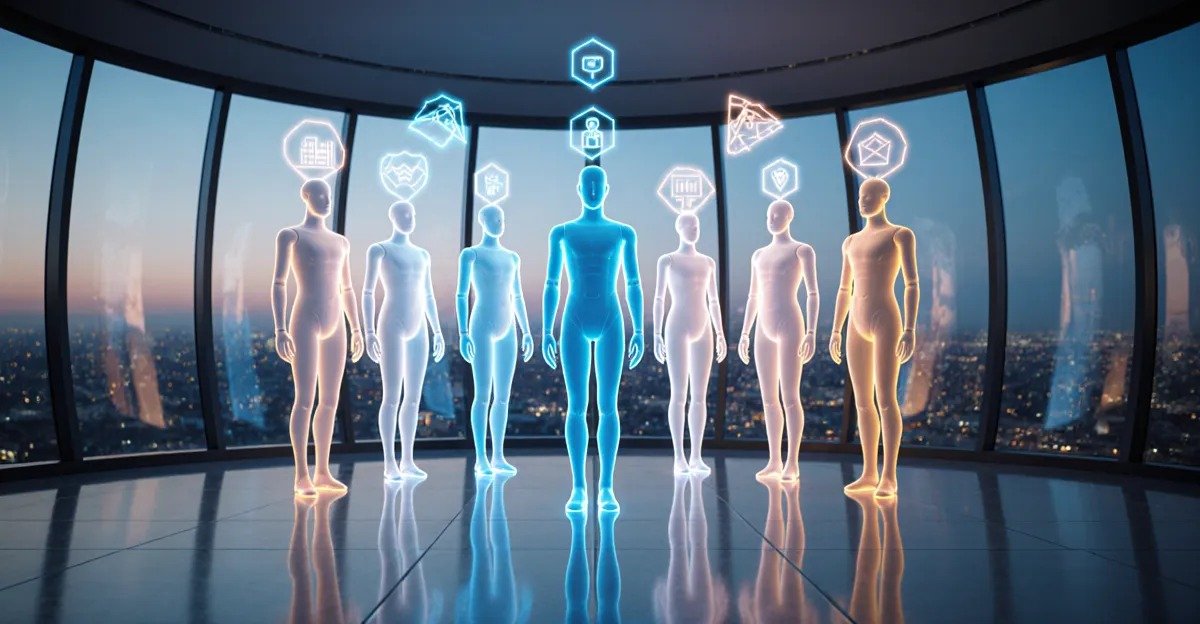
What if your business could run entire departments on autopilot, with specialized AI agents handing tasks to each other like workers on a factory floor? That vision is no longer science fiction. In 2026, multi-agent AI systems are quietly becoming the backbone of enterprise operations, and the numbers back it up.
According to Gartner, 40% of enterprise applications will feature task-specific AI agents by the end of 2026, up from less than 5% just a year ago. And 73% of organizations are now actively exploring multi-agent implementations, making it the fastest-growing segment of enterprise AI investment.
In this article, you will learn what multi-agent AI systems are, how they work in practice, which frameworks are leading the space, and what your business can do right now to get ahead of this shift. Whether you are an entrepreneur, developer, or business leader, this guide gives you a clear-eyed view of the technology reshaping how work gets done.
Multi-agent AI systems are architectures where multiple specialized AI agents collaborate to complete complex, multi-step tasks. Unlike a single AI assistant that handles everything, a multi-agent setup assigns distinct roles to different agents: one might research, another might draft content, a third might review for accuracy, and a fourth might format and deliver the output. Each agent focuses on what it does best.
Think of it like a digital assembly line. Just as a manufacturing line breaks a complex product into sequential steps handled by specialized workers, multi-agent AI workflows break a complex business process into coordinated steps handled by specialized agents. The result is dramatically better outcomes: research from 2026 shows multi-agent implementations deliver 3x faster task completion and 60% better accuracy compared to single-agent setups.
The business case is already proven. Workday recently launched hundreds of new AI agents spanning HR, Finance, IT, and Legal, creating coordinated pipelines where agents pass context and outputs to each other automatically. Amazon is deploying conversational AI agents on millions of product pages. JPMorgan Chase has reclassified its AI investments from R&D to core infrastructure, with a $19.8 billion technology budget and 2,000 dedicated AI staff. These are not experiments: these are operating decisions made by some of the largest organizations on earth.
The engine that makes multi-agent AI systems function is called orchestration: the coordination layer that determines which agent does what, when, and in what order. In 2026, five core architecture patterns have emerged as the dominant approaches for enterprise AI automation.
The Supervisor/Worker pattern places one orchestrator agent in charge of delegating subtasks to specialized worker agents. The Peer-to-Peer pattern allows agents to pass work directly to each other based on output type. Hierarchical patterns stack multiple layers of orchestrators. Pipeline or Sequential patterns route tasks through agents in a fixed order. Marketplace or Auction patterns let agents bid for tasks based on current capacity and expertise.
In practice, most mature enterprise deployments combine patterns. A hierarchical outer structure with a pipeline inner workflow is especially common in finance and HR automation.
The leading frameworks powering these architectures are LangGraph and CrewAI. LangGraph provides maximum control through graph-based workflow design, ideal for teams that need precise control over agent state and decision paths. CrewAI specializes in role-driven orchestration, allowing developers to assign personas and responsibilities to each agent in plain language. Both are seeing rapid adoption in 2026, with CrewAI especially popular among teams that want fast deployment without deep infrastructure expertise. For a deeper comparison of agent frameworks, see this guide to LangChain vs CrewAI vs AutoGen on BigAIAgent.
The most valuable multi-agent systems in 2026 are not replacing entire teams: they are handling the high-volume, repetitive, and time-sensitive workflows that humans often find draining. Here is where organizations are seeing the greatest impact from autonomous AI agents.
In finance, agents are handling cashflow monitoring, scenario modeling for planning cycles, automated KPI alerts for margin control, and portfolio management dashboards that allow advisors to oversee dozens of client accounts simultaneously. JPMorgan Chase’s AI-powered trading and risk systems are a leading example, with the bank treating agent infrastructure the same way it treats data centers: as foundational.
In customer experience, Accenture’s investment in Netomi has created no-code orchestration platforms where coordinated AI agents anticipate customer needs and take action across support, sales, and fulfillment channels without human handoffs.
In HR and operations, Workday’s Sana conversational AI now spans both HR and finance systems, allowing employees to ask natural language questions and receive answers pulled from live organizational data, with agents routing requests, verifying permissions, and surfacing insights automatically.
Organizations implementing enterprise AI automation strategies in 2026 are reporting 30 to 50% process time reductions. Nearly 90% of buyers report higher employee satisfaction in departments where agents are deployed, largely because agents absorb the repetitive work humans least enjoy. Most organizations see their first meaningful outcome within three months of deployment.
For a practical starting point, explore this step-by-step guide to building an AI agent pipeline with CrewAI on BigAIAgent.
One of the most important shifts in enterprise AI in 2026 is a change in how organizations think about governance. Historically, governance was seen as a compliance burden: a box to check before deployment. In 2026, mature organizations have flipped this framing entirely. Governance is now understood as an enabler, the thing that gives leadership the confidence to deploy agents in higher-value, higher-stakes scenarios.
This matters because 68% of organizations cite governance gaps as the primary barrier to scaling AI agent deployments. Without clear frameworks for agent permissions, audit trails, escalation paths, and human override mechanisms, organizations get stuck at pilot stage and never reach the scale that delivers real ROI.
The governance trend driving the most adoption in 2026 is the shift from “human-in-the-loop” to “human-on-the-loop.” Rather than requiring a human to approve every agent decision, mature systems place humans in a supervisory role: monitoring dashboards, reviewing exceptions, and intervening when agents flag uncertainty. This dramatically improves throughput while maintaining accountability.
Microsoft’s Agent 365, now generally available, is a strong example of this approach in practice. It enables IT teams to automatically discover, inventory, and perform lifecycle governance across AI agents deployed across AWS, Google Cloud, and Azure simultaneously. If you are planning a multi-agent deployment, governance tooling should not be an afterthought: it is what separates a successful production rollout from a stalled pilot.
The multi-agent shift is still in early innings. Gartner projects that agentic AI could drive approximately 30% of enterprise application software revenue by 2035, surpassing $450 billion. By then, software vendors who have not embedded agent capabilities will be the exception, not the norm.
What will change most between now and then is agent memory, context, and coordination. Today, most agents work within relatively short context windows and hand off outputs as text. The next wave will feature agents with persistent memory, shared state across sessions, and the ability to learn from organizational data over time. Google’s Gemma 4 series, released under the Apache 2.0 license, is specifically designed for advanced reasoning and agentic AI orchestration, and represents the direction the open-source community is moving.
For businesses, the implication is clear: the organizations investing in multi-agent infrastructure today, including the tooling, governance, and internal expertise, are building a durable competitive advantage. The question is not whether multi-agent AI systems will transform your industry. Based on 2026 adoption data, they already are.
Multi-agent AI systems are no longer an emerging technology: they are actively reshaping enterprise operations in finance, HR, customer service, and beyond.
First, the adoption curve is steep. With 40% of enterprise apps embedding task-specific agents by end of 2026, the window to get ahead of this shift is narrowing fast.
Second, governance is not optional. The organizations scaling successfully are the ones that built clear permission, audit, and oversight frameworks before expanding agent deployments.
Third, the right frameworks matter. LangGraph and CrewAI are leading the space in 2026, and understanding their trade-offs will help you choose the right foundation for your AI agent workflows.
To explore more tools, trends, and deep-dives on AI agents, visit BigAIAgent.tech: your destination for everything agentic.
What part of your business workflow do you think is most ready to be automated by a multi-agent AI system? Share your thoughts in the comments below.










1 Comment
[…] Pricing transparency: Many platforms use credit-based pricing that can become expensive fast. Understand the cost model before committing. For more on how businesses are deploying agents at scale, see our guide to multi-agent AI systems and how enterprises are building digital assembly lines. […]